How one of the world's most comfortable hammocks is made: Secrets of craftsmanship from Mexico
 Rafał Dworak · Hammockia
· 16 min read


In this article
Somewhere in the hot Yucatan, in the shade of palm trees and colorful houses, an artisan has been hand-weaving threads for many hours. A hammock is slowly taking shape, in which, a few weeks from now, someone on the other side of the world will rest after a hard day, listen to the rustle of trees, and catch a moment of true peace.
This is exactly how traditional Mexican hammocks, considered among the most comfortable in the world, have been made for generations.
Their secret lies neither in modern technology nor mass production. It is the result of centuries-old tradition, experience, and the manual weaving technique passed down within families from generation to generation.
We had the opportunity to see this process up close during a trip to the Yucatan Peninsula. Moreover, we tried our own hand at beginning to weave a hammock on a traditional loom.
Only then did we truly understand how much patience, precision, and experience goes into making a single piece.
In this article, we will show you what a Mexican hammock is made of, what the work of local artisans looks like, and why its characteristic, hand-woven construction provides comfort that is hard to find in ordinary mass-produced hammocks.
A hammock woven into the history and culture of the Yucatan
The history of Mexican hammocks is inextricably linked to Mayan culture and the hot, humid climate of Central America.
An airy surface suspended above the ground works perfectly in tropical heat. Air can flow both over and under the body, and the person resting does not have contact with the heated floor or ground.
To this day, in many homes on the Yucatan, a hammock is neither a decoration nor a seasonal garden accessory. It is a daily place for rest, sleep, and family life.
The walls of houses often feature special hooks. In the evening, hammocks are hung on them, and in the morning, they are folded away, reclaiming usable space in the room. Each family member may have their own hammock, tailored to their needs.
In the region, there are even people who specialize in repairing damaged hammocks. Thus, a worn-out piece does not always end up in the trash. You can repair its weave, replace threads, or restore a damaged end.
This shows that a hammock is something much more important there than just a vacation gadget. It is a part of everyday life.

On the Yucatan, the hammock has been a natural place for sleep and rest for generations—even for the youngest.
Manual labor instead of mass production
The biggest difference is visible right at the start of production.
Authentic Mexican hammocks are not made on an assembly line. Each piece is crafted by hand on special, adjustable frames resembling traditional looms.
Such structures often stand in backyards or under covered parts of the artisans' homes. Thanks to the ability to adjust the spacing of individual elements, hammocks of various sizes can be made on a single frame—from single-person models to large, family-sized XXL hammocks.
Depending on the size, weave density, and complexity, making one hammock can take anywhere from a few days to several weeks of work.
Every thread is guided by hand, with immense precision and experience gained over years.
This is why every hammock is unique. Minimal differences in the weave, color arrangement, or thread tension mean that no two pieces are exactly identical.
This is not a product from a production line.
This is true, increasingly rare craftsmanship.

What does hammock production begin with?
The first stage is choosing the right thread.
Its material, thickness, and elasticity affect comfort, breathability, durability, and the way the finished hammock conforms to the body.
In traditional hammocks, you will find both cotton and synthetic threads. Each material has different properties and performs well in slightly different conditions.

Thin cotton thread
A thin cotton thread allows for a very dense and delicate weave.
A large number of thin threads ensures that the hammock surface conforms precisely to the body's silhouette. The body weight is distributed evenly, rather than resting on a few noticeably firm cords.
This solution is particularly valued in hammocks intended for long relaxation and sleeping.
Cotton is soft, breathable, and pleasant against the skin. It works best indoors, on a covered terrace, and in places where the hammock is not constantly exposed to rain.
Thicker cotton thread
Thicker cotton creates a meatier and more elastic weave. The hammock can sag more deeply under body weight and wrap more snugly around the user.
This way of the material working is often especially appreciated by children, who like to sink deeper into the seat.
However, comfort is not determined solely by the thickness of the thread. The width of the hammock, the density of the weave, and the position assumed during rest are also of great significance.
Thin synthetic thread
Thin synthetic fibers allow for a relatively delicate and elastic weave, while simultaneously absorbing less moisture than cotton.
As a result, they may work better in hammocks used in a garden or in places with higher humidity.
Thicker synthetic thread
A thicker synthetic thread is usually more resistant to abrasion and mechanical damage. It can be a good choice where the hammock will be used particularly intensively.
Thus, there is no single ideal material for all applications. The best choice depends on where and how the hammock will be used.
The secret to comfort: thousands of elastic threads
One of the most important elements of a traditional Mexican hammock is its characteristic corded construction.

A seat made of soft cotton:
- is breathable and pleasant for the skin,
- works well under body weight,
- does not create a rigid surface,
- does not heat up as much during hot weather,
- provides comfort even during long periods of rest.
The weave itself is also of enormous importance.
Hundreds, or in larger models even thousands, of thin and elastic threads create a surface that conforms to the user's silhouette. Each of them can slightly change its position under the influence of body weight.
Thanks to this, the pressure is distributed over a large surface, and the hammock does not create uncomfortable pressure points.
The effect?
A feeling of light suspension and being cradled, which is difficult to experience in classic fabric hammocks.
A traditional loom in the heart of the home
Mexican hammocks are made on special, adjustable frames resembling simple looms.
These structures often stand in the central part of the yard, on a terrace, or in a covered part of the house. This allows the work to be carried out close to the family's daily life.
The workshop is not a separate production hall. It is a natural part of the home.
In the hot climate of the Yucatan, a fan is often found near the workspace. In traditional homes, you can also see small shrines and items related to family life.
Although the workspace looks modest, the actual making of a hammock requires extensive knowledge and extraordinary accuracy.

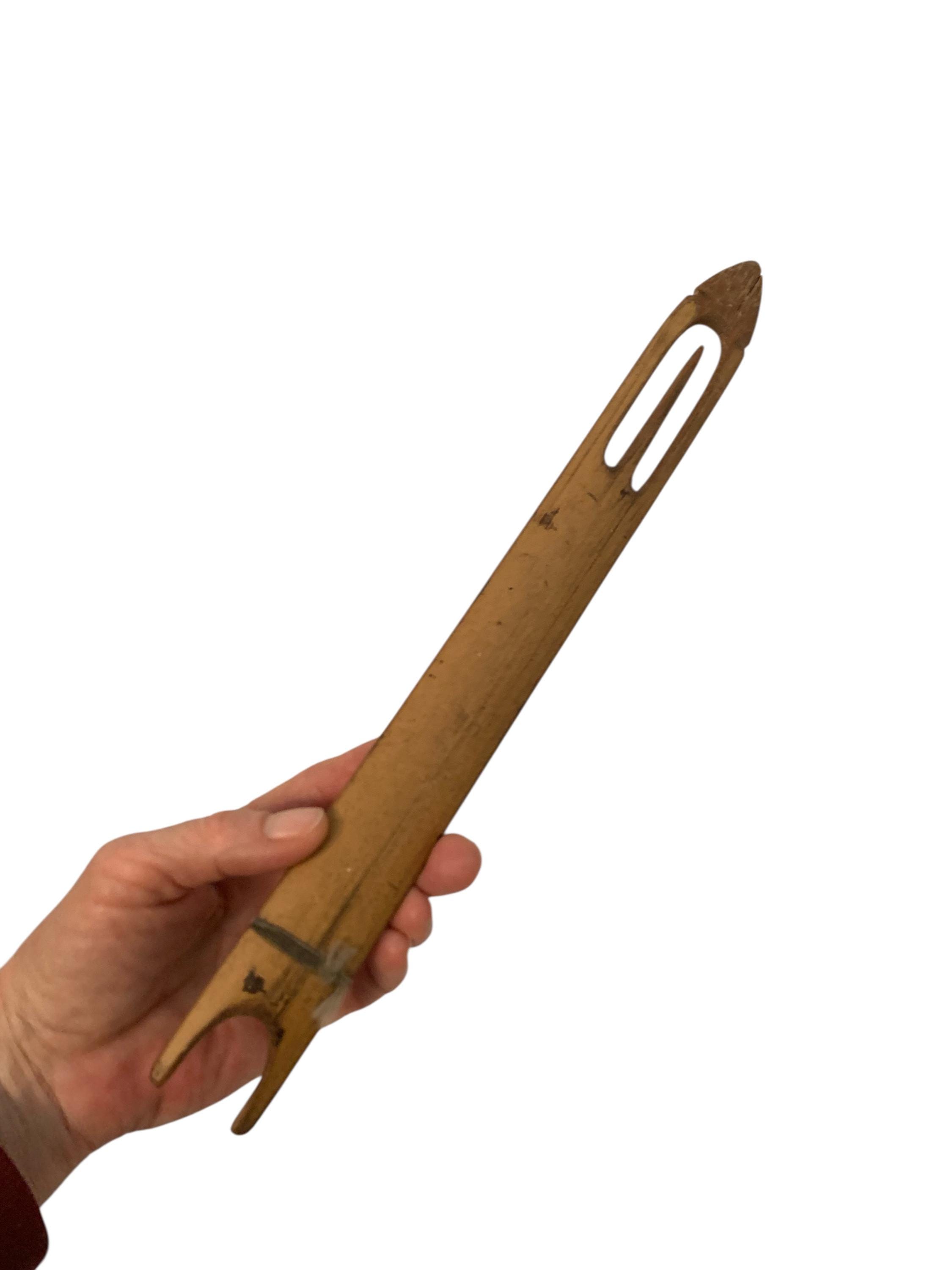
A traditional loom for weaving a Mexican hammock. A supply of thread is wound onto a wooden needle, called "aguja" in Spanish, which unspools as the work progresses.
Aguja: the wooden needle for weaving a hammock
The artisan's primary tool is a special wooden needle, called aguja in Spanish.
A supply of thread is wound onto the needle, which gradually unspools during work. The artisan then passes it between successive loops, creating an elastic, openwork surface.
The size of the needle must be matched to the thickness of the thread and the density of the planned weave.
The thinner the thread and the denser the hammock is woven, the smaller and more precise the aguja should be.
The tool itself looks very simple. However, using it skillfully requires years of practice. Each loop must be of the appropriate size, and the thread tension should remain as even as possible across the entire surface of the hammock.
How is a Mexican hammock woven?
The process of creating a traditional hammock consists of several stages. Each part of the construction is executed in a slightly different way, but all elements must ultimately form one cohesive whole.
1. Preparing the loom
At the beginning, the frame is set up according to the planned dimensions of the hammock. The length and proportions of the finished model depend on the proper spacing of the elements.
2. Creating the first edge
Work begins at the side edge of the usable surface.
This is one of the most important stages because it determines the width and proportions of the entire hammock. The threads must be spaced at equal intervals and properly tensioned.
3. Weaving the middle part
Next, the actual seat is created. The artisan gradually weaves successive rows of threads, creating an elastic, openwork surface.
This is the most time-consuming stage of the work. One must constantly check:
- seat width,
- regularity of the loops,
- thread tension,
- symmetry of the construction,
- color distribution.
4. Creating the second edge
After finishing the middle section, the opposite edge is created. It must match the first one and maintain the correct proportions.
5. Weaving the arms
Tapering arms are made at the ends of the hammock.
Their task is to gather the large number of threads forming the seat and evenly transfer the weight to the suspension points.
Correct execution of the arms is of great importance for the stability and durability of the entire structure.
6. Finishing and quality control
The finished hammock is thoroughly inspected. Inspections cover, among other things:
- proportions,
- symmetry,
- thread tension,
- weave density,
- execution of the edges,
- finishing of the arms,
- color distribution.
Only after this stage is complete is the hammock ready for use.

Why you cannot rush while weaving
Making a hammock requires calm, patience, and a "steady hand."
If an error is noticed only after several rows have been completed, it is often impossible to fix just one loop.
The construction must be unraveled to the point where the mistake occurred, and then the entire section must be redone.
The later an error is detected, the more hours of work must be repeated.
This is why experienced artisans work without haste, regularly checking every successive stage.
How much time does it take to make one hammock?
Work time depends primarily on:
- the size of the hammock,
- thread thickness,
- weave density,
- number of colors used,
- complexity of the pattern,
- experience of the artisan.
A simpler model can be created in a few days. A very large, densely woven, and multicolored hammock may require even several weeks of work.
The most time-consuming pieces are sometimes created over about three weeks.
This is not a process that can be accelerated by increasing machine speed. Every loop and every change of color are executed by hand.

Our hammock weaving lesson in the Yucatan
During our stay in Mexico, we visited one of the houses where traditional hammocks were made. We had the opportunity not only to observe the local artisans at work but also to try our hand at the loom.
At first glance, the movements seemed simple. The wooden needle passed between successive threads, creating regular loops.
However, when we began the work ourselves, it quickly turned out that every action requires full concentration.
Even the first edge of the hammock must be measured very precisely. The threads must be spaced at equal intervals and tied with appropriate tension.
A single loop that is too loose or too tight is enough to disturb the proportions of subsequent fragments.
After an hour of work, the piece we made was still very small. As beginner artisans, we would probably need at least a dozen or so days to finish a full-size hammock.
This lesson made us realize how much knowledge lies behind movements that, in the hands of an experienced artisan, look light and natural.
Why is the lack of a spreader bar so important?
Many people associate hammocks primarily with wooden bars on the sides. Meanwhile, in traditional Mexican models, they are intentionally not used.
And this is one of the greatest secrets to their comfort.
The absence of rigid elements means that the hammock naturally cradles the body and adapts to the user's position. The construction remains elastic instead of forcing a specific body layout.
In a Mexican hammock, it is best to lie slightly diagonally. Then the weave expands, the body settles more flatly, and the weight is evenly distributed.
Spreader bars are, however, used in other constructions, such as some hanging chairs and spreader bar hammocks. The wooden elements of such models also require careful preparation.

In the picture: Tropical XXL hammock
Size is determined primarily by width
Hammocks of different sizes can have a similar total length. Their capacity is determined primarily by the width of the usable surface and the amount of thread used to make it.
It is the width that influences whether the hammock will comfortably accommodate:
- one person,
- an adult with a child,
- a couple,
- several people,
- the whole family.
A larger hammock also provides more possibilities for comfortable lying diagonally.
Does a hammock's weight say anything about its size?
Smaller hammocks can weigh about one kilogram, while the largest family models reach a weight of several kilograms.
Greater mass often means:
- greater surface width,
- larger number of threads used,
- denser weave,
- more elaborate arms.
However, weight alone is not a sufficient indicator of quality. The type of thread, regularity of the weave, and the diligence of execution are equally important.

In the picture: Oceano XL hammock
Comfort during the hottest weather
The traditional, open weave has yet another huge advantage—excellent breathability.
Air flows not only over the body but also underneath it. Thanks to this, even on hot days, the hammock remains pleasantly airy and does not cause the effect of solid material sticking to the skin.
This is exactly why corded hammocks have worked for generations in the hot climate of Mexico and the Caribbean.
Their construction was not created as a fleeting trend. It developed over years of daily use in a place where high temperature and humidity are a natural part of life.
Traditional patterns of Mexican hammocks
Colorful hammocks can be made in many styles. Among the traditional ways of arranging colors, one can find patterns known as sinta, arroz, and jaspeado.

Sinta
The name refers to the Spanish word for a ribbon or strap.
The colors are arranged in adjacent stripes. They can form harmonious transitions or distinct, contrasting compositions.
Arroz
The word arroz means rice in Spanish.
In this pattern, colored stripes are complemented by fine interweaves of other colors. As a result, the surface gains a more complex and decorative character.
Jaspeado
This is a pattern resembling mélange or delicate mottling.
Two colors intertwine alternately, creating an irregular effect. Up close, individual threads are visible, while from a greater distance, the colors blend optically.
Because every pattern is made by hand, two hammocks in similar colors do not have to look identical.
And that is precisely where their charm lies.
Colors inspired by Mexico
The distinctive, intense colors of traditional Mexican hammocks are not accidental.
The patterns and color combinations evoke the turquoise waters of the Caribbean, exotic fruits, colorful house facades, tropical vegetation, and the warm light of the southern sun.
Every change of color requires manually introducing a new thread into the construction. In more complex patterns, this action must be repeated many times.
The artisan, therefore, does not just create a functional structure. They also create a color composition that gives the hammock an individual character.
 |
 |
 |
Craftsmanship that sustains entire communities
Weaving hammocks is an important source of income for many families on the Yucatan Peninsula.
In some towns, a significant portion of the inhabitants is engaged in this craft. Knowledge regarding the selection of threads, preparation of the loom, needlework, and executing patterns is passed down within families through successive generations.
Working on hammocks supports household budgets and helps finance daily needs and children's education.
Behind every handmade piece, therefore, lies not only material and time, but also the story of a specific person and their local community.

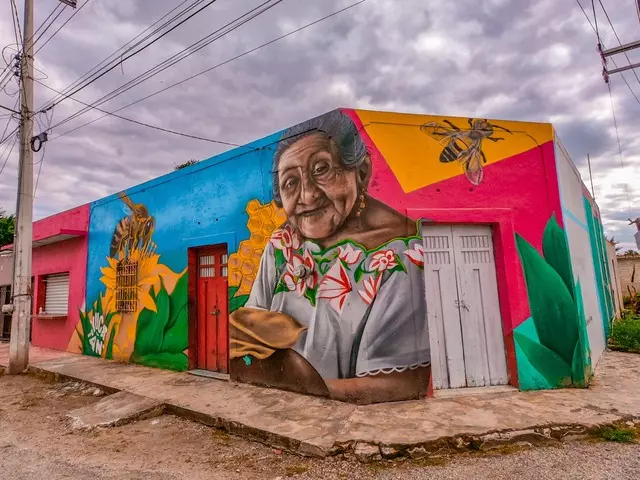
A photo taken in Mani - a small town in the Yucatan where Mayan heritage, local traditions, and daily life are still deeply intertwined. Maní has retained the peaceful character of a traditional town, with colonial architecture, family courtyards, and crafts practiced close to home.
 It is precisely in such places that it is best seen that hammock weaving is not a tourist show, but a part of everyday life and a skill passed down through generations.
Every hammock is slightly different
In factory production, the goal is for all items to look identical.
In the case of handicrafts, minor differences are natural. They may concern:
- the arrangement of individual threads,
- color placement,
- the length of the ends,
- small elements of the weave,
- dimensions within a specified tolerance.
These are not defects. They are proof of manual workmanship and give the product its unique character.
Every hammock is created separately and passes through the hands of a specific person.
Why is it worth choosing an authentic Mexican hammock?
By choosing a hand-woven hammock from Mexico, you gain much more than just an attractive piece of furniture for your home, garden, or patio.
It is a combination of:
- centuries-old tradition,
- manual labor,
- the experience of local artisans,
- a flexible and breathable weave,
- exceptional comfort for relaxation,
- unique design.
You also support the preservation of skills that are gradually disappearing in many parts of the world under the influence of mass production.
A traditional Mexican hammock is not just a place to rest.
It is a fragment of a more peaceful lifestyle that you can bring into your own home.
If you want to feel the comfort of a hand-woven hammock inspired by the centuries-old tradition of the Yucatan, discover the collection of authentic hammocks available at Hamakija.pl.
See the collection of Mexican hammocks
Craftsmanship you can feel while resting
The process of creating a hammock shows how much patience, experience, and human handiwork go into its weave. Ultimately, however, it is not just about the method of manufacture. All those hours of work translate into something you can feel the moment you lie down in a hammock - its flexibility, breathability, and exceptional body contouring.
If you want to learn more about why manual craftsmanship still outperforms mass production and what makes every traditional hammock slightly different, also read:
Hand-woven hammocks. Why traditional craftsmanship is still unrivaled?
This article shows not only how a Mexican hammock is made, but also the people, places, and tradition standing behind every single piece. The second text is its natural complement - it explains why this method of manufacture is so important for daily relaxation.
Recommended articles: